 Ohm
Ohm
The title is the argument.
“P ★ K I” is pronounced “Pee Star Kay Eye”. It is the title of Ahad Elley’s debut album on Island Records, and it takes back a word. Elley, who records as Ahadadream, grew up hearing it used positively in Pakistan, and only met its use as a racial slur after moving to the UK. He is direct about what he is doing with it: “a word that I have personally been confronted with,” reframed as “a positive body of work that is all about joy, celebration, pride and self-love.”
The album arrived September 18, 2026, with a Mixmag cover and eleven tracks. Elley describes it as a love letter to his younger self. If you have not heard it yet, this is the case for why you should.
What the music actually is
Ahadadream has been making club music in the UK underground since the early 2010s, recording mixes for BBC Asian Network, BBC 1Xtra, Nasty FM, and Reprezent FM. UK bass, grime, garage, UK funky, dubstep — he came up through all of it. Fifteen years of that practice, all arriving at once.
What “P ★ K I” sounds like: UK funky’s fractured rhythmic grid, the sub-pressure dubstep brought to the underground, South Asian instrumentation woven through the structure rather than layered on top, and gqom and baile funk as wider reference points. Ahadadream calls it “the South Asian sounds pairing with the UK-grown sounds.” Neither side is decorative; neither concedes to the other.
The collaborators give you the range. Capo Lee, Eliza Rose, Jolie P, Dismantle, and Jamakabi appear across the eleven tracks. Backing from the wider scene includes Peggy Gou, Four Tet, Fred again.., and Ben UFO — a group that does not end up on comfortable crossover projects.
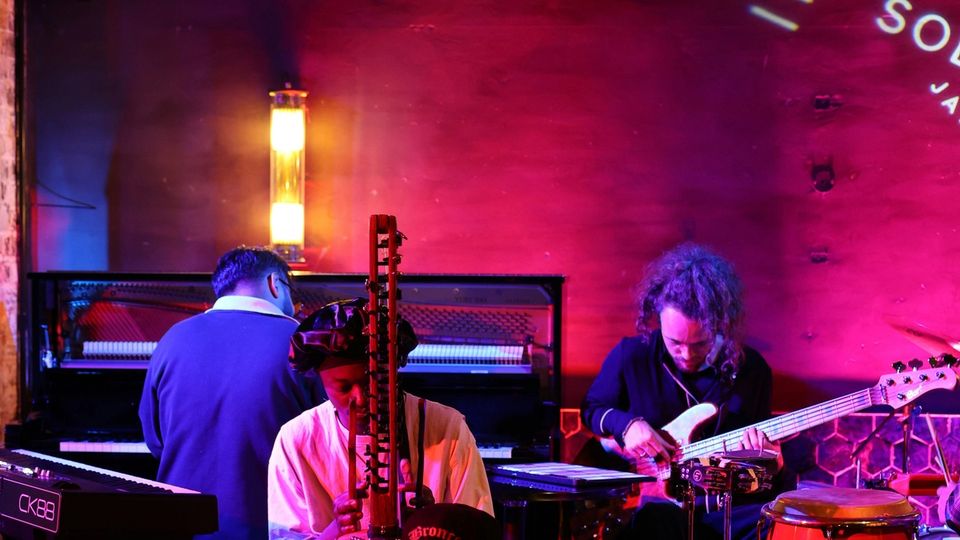
The Mixmag Lab recording, made live at The Carpet Shop in Peckham, is the clearest document of what this music does in a room. For that session, Ahadadream gathered the album’s guest collaborators together — the first time these songs existed outside the studio. He described it this way: “it was the first time we bought [sic] some of the music to life, performing the vocals live.” Elley had been to Karachi and Lahore in the weeks before, and the session carried weight: “It felt incredible to be coming back from Karachi and Lahore to London, celebrating the album in the two places that informed it most, back to back.”
The title is not incidental
Elley moved to the UK from Rawalpindi at thirteen. The Mixmag cover feature covers the years that followed: finding UK club culture from the inside, building a career in an underground where he did not consistently see himself represented, adjusting to the specific reality of being South Asian in Britain.
“When I moved over to the UK, there were certain parts of my identity that I tried to mask, or hide, or shrink - for survival…this album is my chance to do the opposite of what I was doing then. I’m loud and I’m here.”
The album does not mourn that difficulty. It inverts it. The dancefloor is the space where the inversion is performed, and has always been: “I’ve always viewed the dancefloor as a space where you can loudly and defiantly be your whole self.”
What Dialled In has built
“P ★ K I” does not arrive without infrastructure behind it. Ahadadream co-founded Dialled In in 2021 with Dhruva Balram and Provhat Rahman, building on No ID parties that had been running at Rye Wax in Peckham since 2019. Dialled In Records describes itself as “a new home for forward-thinking South Asian music.” By 2024, Dialled In had brought their platform to Glastonbury, curating the Arrivals Takeover at Glastonbury, which Mixmag described as the first South Asian platform at the festival.
The need came from a clear diagnosis. South Asian representation was absent “not just on line-ups but on dancefloor too, despite each scene having talent that just happened to be South Asian in them.” Dialled In was built as the answer to that gap, and the response at events proved them right: “You could see the palpable joy. People were crying, people wrote poems about it.”
The sequence matters here. Elley built the platform and the community around it first. The album arrives after the foundation exists, as the record that the platform was always pointing toward.
For DJs who think about what they play
Records say things. A warm-up DJ spends three hours communicating something before the headliner arrives, and the selections are the argument. “P ★ K I” is built to communicate deliberately. If you play UK bass, music that draws on South Asian rhythmic traditions, or any of the global club genres that have pushed the underground forward over the last decade, it belongs in a set and says something when it does.
The Island Records backing and the Mixmag cover do not change what it is. It is eleven tracks of music made for club sound systems, built by someone who moved to London at thirteen, spent fifteen years in the underground, and refused to leave his identity at the door.
“Honestly, I’m just relieved these songs are out in the world now. I’ve spent years playing them, then tweaking them a bit, then playing them again.”
They are out now. Find them.